 COHERENCE
An invoice says what the customer owes. It rarely settles the next operational question by itself: who should follow up, whether a milestone is complete, or what the team promised before the bill went out.
If that is why you're looking for a FreshBooks alternative, Coherence is worth evaluating. It gives customer teams one-time invoices connected to Accounts, with payment history and balances inside the workspace they use to coordinate customer work.
Coherence is the better fit when the missing piece is customer operations around the invoice. FreshBooks remains the better fit when the missing piece is accounting or recurring service billing. Replacing one with the other only makes sense after separating those jobs.
What this comparison is based on
Coherence publishes this article. We reviewed FreshBooks' official product and pricing documentation on September 23, 2026, and verified Coherence's invoice, payment, and Account views using illustrative data in a local development workspace. We did not run a hands-on FreshBooks trial or measure comparative performance. The recommendations reflect the workflows below, not a claim that either product wins every category.
What you would be changing
| Decision | FreshBooks | Coherence |
|---|---|---|
| Where to begin the evaluation | Billing and financial administration | Account management and customer work |
| Invoicing model | One-time and recurring invoices | One-time invoices in this release |
| Accounting requirement | Accounting and reconciliation capabilities | Keep a separate accounting system where needed |
| Customer-team workflow | Evaluate its client and project tools | Accounts, related invoices, tasks, documents, and collaboration in the platform |
| Plan decision | Billable-client count and required financial features | Pro or Team, plus invoice role permissions |
FreshBooks' recurring billing and time-to-invoice capabilities are documented on its invoicing page. Its accounting page covers financial reports and reconciliation. Coherence's invoicing overview defines the current release's scope.
Where FreshBooks deserves to stay on the shortlist
FreshBooks has client and project tools as well as invoices. Its project offering includes collaboration and project financial visibility; it would be misleading to describe it as merely a PDF generator. FreshBooks projects and collaboration
For a consultancy that builds bills from tracked work and needs recurring billing, deposits, or automated reminders, FreshBooks offers useful depth. FreshBooks invoicing
It also supports an accountant's work through journal entries, a chart of accounts, financial statements, and bank reconciliation. Coherence's invoice ledger does not replace those capabilities. FreshBooks accounting
If the product is already doing those jobs well, keep that fact at the center of your decision. A new account view is not sufficient reason to disrupt your books.
Where Coherence changes the working day
Consider a service team working with Northwind Logistics. The dispatch assessment is settled, a fleet rollout is halfway paid, and the next support invoice is open. The account owner needs those distinctions before deciding what to discuss at the next check-in.
In Coherence, the Account's Invoicing tab shows all three invoices with their payment states and balances. Creating a new invoice there starts with the Account selected. A separate optional deal or project reference can identify the work behind the bill.
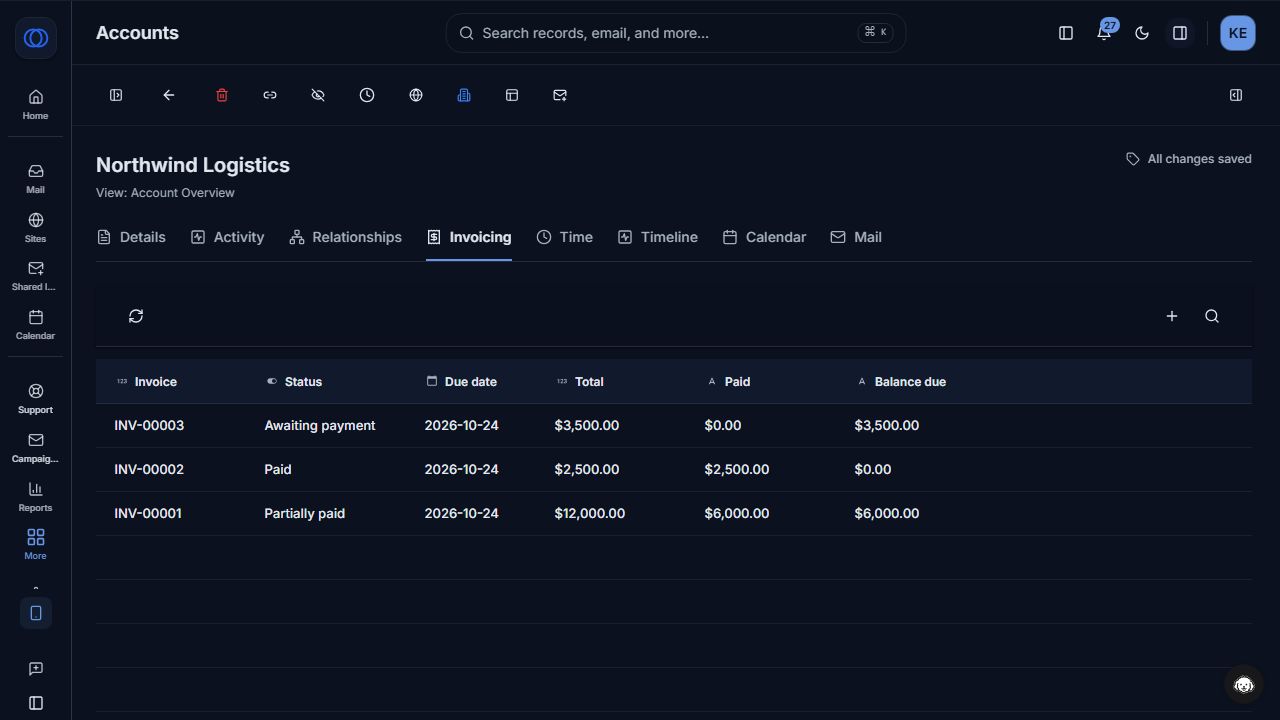
Actual Coherence UI. Northwind Logistics is used here as an illustrative demo; the invoices and receipts are fictional.
The advantage is access to the billing state while you're working on the customer relationship. After reviewing a balance, a teammate can coordinate the next step through the platform's tasks, records, documents, and conversations. That is a human decision; the invoice feature doesn't automatically authorize a project milestone or send an AI-written collection message.
This is why we recommend Coherence for teams choosing their customer workspace and needing practical one-time billing within it. The benefit depends on adopting that shared workflow. It does not come from treating every specialist financial feature as unnecessary.
Watch the short Invoicing demo for a closer look at Coherence's account-to-invoice workflow.
Checks and wires can remain part of your process
You don't need to move a customer's established payment process to a card checkout just to create an invoice. In Coherence, add the instructions your business uses, then record a receipt after verifying the payment arrived. Partial receipts reduce the balance without marking the full invoice paid.
That distinction is visible in the Northwind rollout example: $12,000 invoiced, $6,000 recorded paid, and $6,000 outstanding. Recording the receipt updates the ledger; it doesn't deposit a check or verify a wire with the bank.
Stripe card payment is optional. The current Coherence setup creates a connected Stripe account with full Dashboard access; it cannot yet link an existing Stripe account. Stripe processing fees apply, with no additional Coherence transaction fee. Review the setup requirements before choosing online collection.
Compare the cost of the workflow you will actually keep
FreshBooks' US plan matrix limits Lite to 5 billable clients and Plus to 50; Premium supports unlimited clients. It also prices additional team members separately. Those constraints can matter more than a temporary introductory discount. FreshBooks pricing
Coherence Invoicing requires Pro or Team. Compare the total cost of the workspace, payment processing, any accounting tool you retain, and the human work needed to connect them. We aren't claiming a universal subscription saving: a business that still needs its financial system may end up using both products for different jobs.
There is no native accounting-system sync in this Coherence release. Before a rollout, agree which system is authoritative for your financial reporting, who enters any required records, and how outstanding balances will be checked. Don't assume an integration exists because the two products both use the word “invoice.”
Who should not switch their invoicing to Coherence yet?
Keep a specialist financial workflow if your requirements depend on recurring invoices, automatic time or expense conversion into invoice lines, credit notes, bank-feed reconciliation, or accounting reports. Coherence's current invoice release does not provide those functions. It does support reusable Account billing details and Brand logos, with invoice-specific edits and permanent snapshots when issued.
For a smaller decision, test one representative Account and one draft without migrating historical records. Verify the roles, document, payment process, and accounting handoff with the people who will use them.
If that test makes the customer conversation easier while preserving the financial controls you need, Coherence has a clear role. Start with the invoice creation guide and let the workflow determine the migration boundary.
Coherence Team
Product
The team behind Coherence — building AI-native tools for modern businesses.
Related Articles
A HubSpot Invoicing Alternative for Teams Building Their Customer Workspace
Compare Coherence and HubSpot invoicing fairly: CRM context, offline payments, Stripe setup, fees, recurring billing, and the right platform fit.
GoHighLevel Alternative for Customer Operations: Coherence
Compare GoHighLevel and Coherence for websites, campaigns, CRM, and customer operations. Separate agency resale requirements from running your own customer work.
Framer Alternative for Business Websites: Coherence Sites
Compare Framer and Coherence Sites for business websites, form submissions, CRM, and email follow-up. Find the better fit for your customer operations.